Wineries
Marcuzzi Officina Viticola
Giasbana (GO)
La carezza del buccia per imprimere il Collio. Scopri questa intima azienda vitivinicola di San Floriano del Collio.
...A small portion of the Çujevi hill had been sold, prior to World War I, to a family of farmers, the Bizajs, who had built their home on its summit. The surrounding lands had passed from hand to hand among various noble families of the Princely County of Gorizia and Gradisca—which was predominantly under Habsburg control—and which changed over the centuries: from the Herberstein family to the Della Torre family to the Attems family. According to the elders’ recollections, the last owners belonged to the Teuffenbach family, whose residence stood on the nearby Vipulzano promontory. From our cellar, you can still see two villas there: the more recent one, the Teuffenbachs’ primary residence, which has now become a small 12-room hotel; and the older villa, the nobles’ luxurious hunting lodge, which was devastated during the two world wars, known as Villa Vipulze, which was later renovated and now houses a restaurant and the Museum of Slovenian Cultural Heritage. The sharecropped grapes were transported by ox-drawn carts to the count’s private winery in Piuma, where the wine was then produced (this building has also been converted into a 3-room guesthouse—Villa Schloss-Teuffenbach). In fact, the land they owned was managed until the end of World War II by tenant farming families under sharecropping contracts, who were required to split the harvest equally with the landowner. From 1918 until shortly before 1927, the surrounding area was virtually uninhabited, and farmers were brought in from other nearby villages. In particular, our area was entrusted to three families who, starting in 1927, lived in Villa Jazbine (which means “land of stones” in Slovenian), including the Skoks (current owners of Villa Jazbine and its adjoining winery), the Buzzinelli family (future owners of the Çujevi hill), and the Colja family, who later emigrated elsewhere. Unfortunately, it must be noted that during the 1930s, the head of the Bizaj family, owner of Čujevi, died when one of the three bunkers built during World War I collapsed in the immediate vicinity of the house, forcing his mother to raise her children alone. Following World War II and the subsequent redrawing of national borders, the count decided to sell the properties, with the settlers having the right of first refusal. This is how Ignazio Buzzinelli first purchased the eastern part of the hill from the count, and then the remaining western portions, along with Mrs. Bizaj’s farmhouse, except for a plot of just under one hectare located to the east, which passed into the ownership of a Slovenian family named Stekar. Ignazio then passed the hill on to his son, Mariano Buzzinelli, in 1988, and Mariano, in turn, passed it on to his son, Marino, in 1995. In 2016, the Marcuzzi family took over the property, completing ownership of the hill by acquiring the remaining portion from the Stekar family. Since 2019, they have been producing their own wine following the completion of the winery and its adjoining tasting room. And the near future will, in turn, become history…
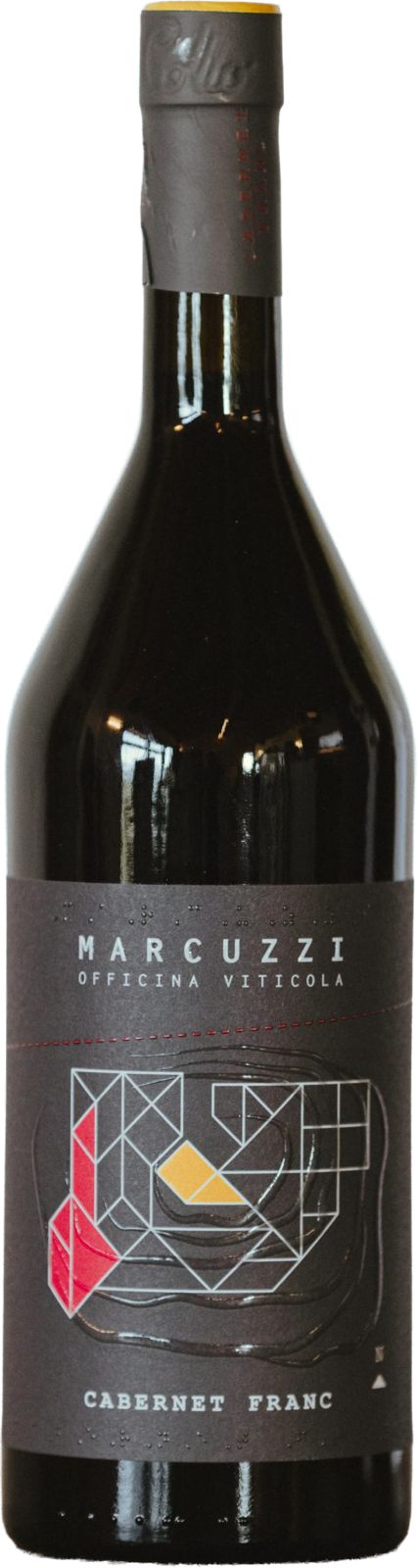
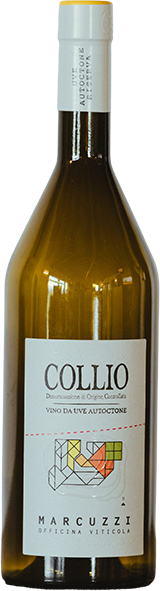
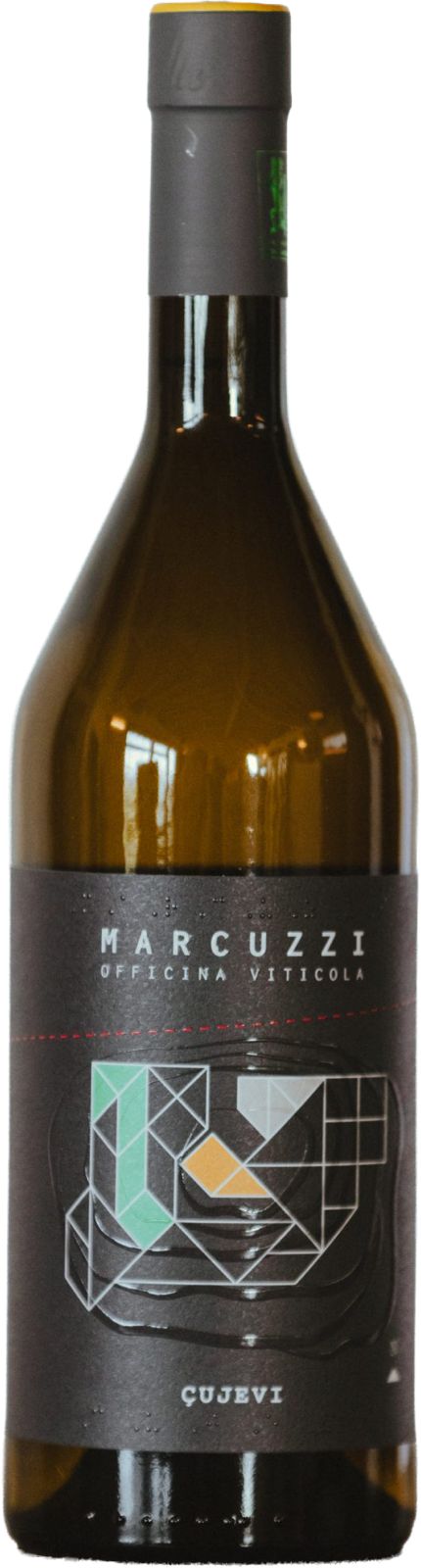
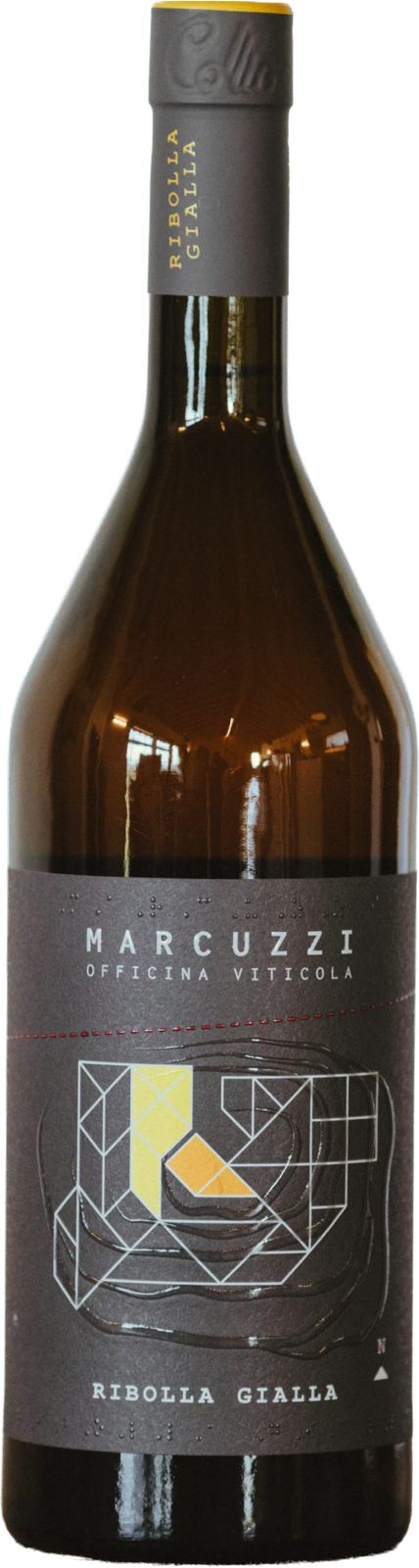
...The winery is situated at the top of a small hill covering about 5 hectares in San Floriano del Collio, known by the Slovenian place name “Çujevi,” meaning “stump.” To the north lies the border with Slovenia, marked by old yellow and red military signs indicating the remaining meters to the border, as well as by boundary markers dating back to the 1950s. On the other sides, the vineyard-covered slope descends via terraces and an older system of retaining walls. The grape varieties grown to the east are Friulano, Malvasia, and Pinot Bianco; to the southeast, Pinot Grigio; and to the southwest and west, Cabernet Franc, Ribolla Gialla, and Sauvignon, respectively. The label itself is intended to represent the various vineyard parcels, grouped by grape variety, all characterized by slopes depicted through raised contour lines. The stylized hill faces north, as indicated by the symbol in the lower right corner. The red line indicates the border, which—despite its significant historical importance—has been depicted as a dotted line to highlight that it is merely an artificial geographical division of the Collio/Brda region, which has always been united geologically, environmentally, and morphologically. My goal is to create “Living Wines” that change and evolve over time and vary from vintage to vintage depending on what nature offers. To achieve this, I strive to extract as many terroir characteristics as possible from the grapes, while respecting the unique qualities of each grape variety. I therefore allow all musts to undergo light skin contact, which can last from a few hours to a few days. Depending on the maceration time, this can take place directly in the press with whole clusters; however, if the time exceeds one night, the grapes are destemmed and placed in fermentation vats. In the latter case, fermentation is spontaneous, using indigenous yeasts. For some wines, to enhance their elegance, we use cryomaceration at a temperature below 12 degrees, relying solely on water-cooled jackets inside the stainless steel tanks; while for other wines, fermentation begins with the skins left in the tank at a controlled temperature to extract tannins and more pronounced characteristics. In terms of winemaking, I receive invaluable professional support from winemakers Erika Barbieri and Alberto Faggiani, who have guided the development of my winemaking journey with seriousness and precision, selecting the most appropriate techniques year after year to achieve the desired final result.